

by James Averitt, on Jul 10, 2026, 9:14:12 AM
Forklifts caused nearly 60 avoidable deaths between 2024 and 2025
The National Safety Council reports that 84 people died as a result of forklift accidents in the U.S. during that period. OSHA estimates that 70% of workplace accidents are avoidable. So by the numbers, nearly 60 lives could have been saved with appropriate safety measures. If you want a visual, that’s roughly three times the workforce of the average warehouse.
You know your team’s safety is what matters most.
Like so many other managers, you take great pains to protect yourself and your associates. Yet, no one is perfect, and often, what you don’t know is what hurts you.
With decades of experience in warehouses throughout Florida and Georgia, we’ve seen it all. Most warehouse safety risks start out as small, innocent issues that grow into monsters.
Read on to learn the seven most common warehouse safety risks we see and how to fix them.
1. Dock Drop-Offs
No-so-fun fact: falls account for 17% of workplace deaths, according to the National Safety Council.
When we think of fall hazards, we often think of ladders and scaffolding. Yet, your associates are most likely to fall on your loading dock than anywhere else.
Loading dock falls occur for many reasons, but weather and trailer connections are among the most common.
Weather and Trailer Connections
Florida and Georgia are hot, wet states for much of the year.
In summer months, sweltering warehouse air can be suffocating. Leaving loading dock doors open for ventilation is a common solution, but it also creates a hazard. Busy or unwary workers can easily fall off the dock when doors are open.
While dock doors are rarely left open during stormy weather, loading and unloading trailers expose dock floors to the rain. Wet floors are slick, increasing the risk of falls.
Traversing the trailer connections themselves also risks a fall.
The junction between the dock and the trailer is rarely seamless. Gaps create room to fall, while uneven surfaces are tripping hazards. Add obstructed vision, and you have a recipe for disaster.
Still, the risk can be manageable.
Dock Drop-Off Solutions
Engineering controls are your best option for preventing falls.
Depending on your situation, any or all of these can improve your loading dock safety:
- Safety barriers. Safety barriers physically block access to open docks without limiting air circulation.
- Dock door seals and shelters. Seals and shelters fill the gaps between the dock and the trailer. They provide both a personnel barrier and weather protection.
- Dock levelers. Dock levelers create a smooth, secure transition between the dock floor and the trailer bed, eliminating tripping hazards.
Many warehouses underutilize these easy loading dock safety tools, even when they pay for themselves in accident prevention.
2. Trailer Creep
Trailer creep is a specific falling hazard that merits special discussion.
During loading and unloading, forklifts move back and forth between the dock and the trailer. These heavy machines can rock even a full trailer, causing it to gradually creep away from the dock. Eventually, the separation increases to the point where the forklift’s wheels fall into the gap. The unit’s weight shoves the trailer forward, and the forklift falls from the dock.
These accidents are frequently fatal for the operator.
Trailer Creep Solutions
OSHA requires trailer restraints during loading and unloading.
To meet this standard, many operations settle for simple wheel chocks. These are a great secondary measure, but shouldn’t be a first line of defense. Loading dock restraints provide superior protection. Mounted beneath each loading dock door, these simple devices automatically attach to the trailer and secure it to the loading dock. Normal forklift traffic won’t dislodge them, eliminating trailer creep.
Loading dock training is also vital.
Trailer creep isn’t intuitive for most people. Consequently, operators and workers need training to help them identify and address warning signs before they escalate into accidents. Additionally, operators need training on what to do if their forklift falls from the loading dock. Instinct compels many operators to jump clear. However, accident investigations show this technique actually increases the risk of fatality. Instead, operators should brace themselves and keep all limbs inside the cabin during a fall.
Restraints save lives, but training ensures proper use.
3. Forklift vs. Pedestrian
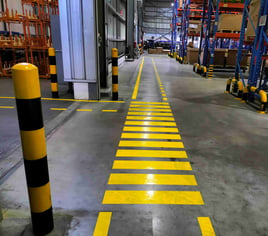 When a forklift and a pedestrian collide, the forklift always wins.
As a result, pedestrian safety is crucial to overall warehouse safety. However, it is often minimized due to correlation bias. Most Americans grew up around cars, and many of us cross the street every day without even thinking about it.
Many people assume crossing warehouse floors is the same. It’s not.
Car designs and traffic laws work to minimize the opportunity for pedestrians and cars to interact. Unobstructed views and pedestrian exclusion zones are common features of roadways. Warehouses don’t have that same luxury. Tall racks and tight aisles limit visibility while daily operations require forklifts and pedestrians to access the same spaces.
The frequency of these interactions significantly increases the odds of an accident.
Warehouse Pedestrian Safety Solutions
There are numerous tools available to address this risk.
These simple forklift upgrades, used in combination, dramatically improve pedestrian safety:
- Warning lights. Amber warning lights are an easy addition that makes pedestrians more aware of a forklift’s presence.
- Blue lights. Blue directional lights illuminate the floor ahead of a forklift, signaling its approach before it arrives at a blind intersection.
- Pedestrian detection systems. Toyota’s SEnS system is an environmental sensor that continuously monitors a forklift’s surroundings and alerts the operator to pedestrians and obstacles.
These pedestrian safety tools don’t replace training; they support it.
4. Racking Damage
Pallet racks are like a Jenga tower.
Every ding and dent is akin to pulling out a block. Eventually, minor damage adds up, and your racking becomes unstable. Left unchecked, the racking can no longer support the same loads and collapses.
There are two ways to nip damage in the bud.
Racking Damage Solutions
The first step is to create a culture of safety.
“It’s no big deal” is a dangerous sentence when it comes to rack damage. Teach your team to constantly scan for damage and report even seemingly minor dents. Addressing small deformities is much easier than extensive repairs.
Rack guards are the second solution.
Used alongside a quality training program, rack guards are highly effective. They come in a wide variety of styles, each designed to protect common impact sites. Yet, their function is the same: the guard takes the hit instead of the rack.
Rack guards are easy to swap out, saving you time and money.
5. Racking Overloads
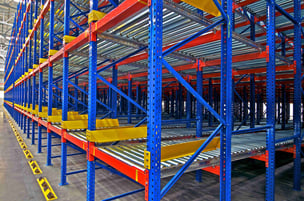 Failure to comply with ANSI MH16.1 requirements for rack load capacity signage may result in OSHA citations.
No one intends to ignore this requirement. Still, frequent use could damage signage while configuration changes render old ones invalid. In the end, you either have an illegible or inacurate signage and risk a rack overload.
Racking Overload Solutions
Training and diligence are the only solutions for this.
Train staff to look for damaged signage and report them. Whenever you update racking configurations, apply new signage with the correct beam load capacity. Finally, train your staff to store heavier loads closer to the ground to promote rack stability.
Quality training and diligent signage are the best protections against overloads.
6. Battery Charging Hazards
Different battery types present different hazards.
Lead-acid forklift batteries contain sulfuric acid, putting your staff at risk of exposure during maintenance and charging. Lithium-ion batteries are prone to thermal runaway, which can occur if they overheat during charging. Both pose a risk of dangerous electrical discharge if mishandled.
Improper handling and charging practices are the most common causes of these hazards.
Battery Charging Hazard Solutions
Always follow the manufacturer’s guidelines when charging any forklift battery.
Different battery designs have different charging needs. Assuming one battery charges the same as another can cause accidents. Ensure all your operators have the training to charge every battery in your facility.
Likewise, proper battery handling is vital.
When charging or performing maintenance on lead-acid batteries, staff must use appropriate PPE. Splashes, cracks, and dropped batteries can easily expose associates to battery acid. PPE helps prevent severe burns. Additionally, charging lead-acid batteries requires a dedicated room. This helps contain caustic chemicals in the event of a spill.
Damaged lithium-ion forklift batteries are more prone to thermal runaway. Following proper handling procedures is critical to preventing impacts and charging damage that can lead to overheating.
That said, overheating is a concern for all batteries. Be sure to monitor temperatures during charging.
7. Missed Inspections
 Most days, your forklifts pass their pre-shift inspections with flying colors.
OSHA mandates these inspections. Still, when things are busy, it’s human to assume all is well and promise yourself you’ll do the inspection next time. Not only is that an OSHA violation, but it also eliminates your chance of catching a problem early.
While they may seem like a chore, pre-shift inspections are your early warning system.
Most equipment malfunctions and failures leave hints before they become a problem. Inspections watch for these tell-tale signs, enabling fleet managers to solve them before they impact safety.
However, when you skip an inspection, you miss all the warnings.
Check out our downloadable forklift safety checklists.
Inspection Solutions
Make inspections a non-negotiable part of every shift.
Pre-shift inspections take five to fifteen minutes but save you days of downtime and protect your staff. Using a formal inspection checklist helps guide operators and promotes compliance by creating a paper trail. Additionally, they provide a powerful audit tool for your company.
If an inspection reveals a necessary repair, don’t delay.
Delayed forklift repairs compound quickly. A simple fix, like replacing a hydraulic hose, can escalate into a serious safety risk that costs you thousands in downtime, workers’ compensation, and emergency repairs.
Stopping to fix a minor issue might seem like a nuisance, but it protects your team in the long run.
Warehouse Safety Made Simple
Top-tier warehouse safety is the intersection of quality training, vigilance, and engineering controls.
There are many easy fixes that will improve safety right away, but those solutions touch every aspect of your warehouse. Some provide instant ROI while others take much longer to pay off. Plus, you can’t do them all at once. Strategic planning is essential, but where do you start?
Our expert solutions team has the answers.
Decades of extensive experience in every aspect of warehouse safety give our team a broad perspective. We can analyze your operation and provide prioritized recommendations, focusing on the most impactful upgrades first. Our team works with you to fit improvements into your schedule and budget, making upgrades easy.
Let us make a safety-first mindset simple.
Contact us online or visit one of our locations to learn more about warehouse safety:
Florida
Jacksonville
Lakeland
Ocala
Orlando
Tampa
Winter Haven
Georgia
Albany
Macon
Columbus
Valdosta
Further Reading
Driven to Safety: Loading Dock Safety Essentials
7 Pallet Rack Safety Tips for Warehouse Managers Who Want Fewer Accidents
Get the Most Out of Your Forklift: Battery Care 101