

by Jethrie Knight, on May 1, 2026 8:36:46 AM
Some folks drive minivans, and others have pickup trucks.
Whatever you drive, daily use is the biggest deciding factor when choosing a car. If you need it to get the kids to football and softball practice in Valdosta, you might choose the minivan. If you sit in Orlando traffic every morning, a hybrid makes sense.
Yet, when you finally get around to your next home improvement project, it'll be a challenge to get all that lumber in the hatchback. That's not an everyday task for most people, and it would be ridiculous to base your whole car purchase on once-a-year events. Still, every so often, you need something different from your daily drive.
For industries with seasonal inventory shifts, forklift fleets experience similar challenges.
Most of the year, your fleet is exactly what you need. Yet, during peak season, demand and inventory changes require more units or models you don't normally rely on. Class II forklifts are a common example. Fulfillment spikes call for more workers on order pickers, and volume shifts demand reach trucks during busy months. Whatever the change in your inventory, the right Class II forklift can make all the difference.
Read on to learn:
- What are Class II forklifts?
- Why do dynamic fleets rely on narrow aisle forklift rentals?
What Are Class II Forklifts?
OSHA defines Class II forklifts as electric motor narrow aisle trucks.
These are the forklifts you want when maximizing storage space by minimizing aisle space. Narrow aisle forklifts operate in areas narrower than twelve feet. Generally, they prioritize maneuverability and lift height over load capacity. This makes them excellent for order picking in high-density warehouses, such as automotive and furniture warehouses.
By definition, all Class II forklifts have a couple of features in common.
All forklifts in this class are electric. Additionally, the vast majority of units feature cushion tires designed for indoor use.
Within the Class II category, there are three foundational model types.
Very Narrow Aisle Forklifts
Very narrow aisle forklifts excel in spaces so tight that turning the whole forklift isn’t an option.
These designs allow the operator to drive into an aisle and retrieve product without rotating the forklift’s body. Different models use various design strategies to meet this demand. Some use articulated forks that swivel 180 degrees. Others reimagine maneuverability entirely.
For example, Combilift forklifts feature four-way movement.
Instead of turning the chassis, these forklifts simply change drive directions. This unique design allows them to move forward, backward, left, and right without rotating. Consequently, these very narrow aisle forklifts handle both standard pallets and long, awkward loads with unmatched agility.
Whatever the design, very narrow aisle forklifts are ideal for the tightest spaces.
Reach Trucks
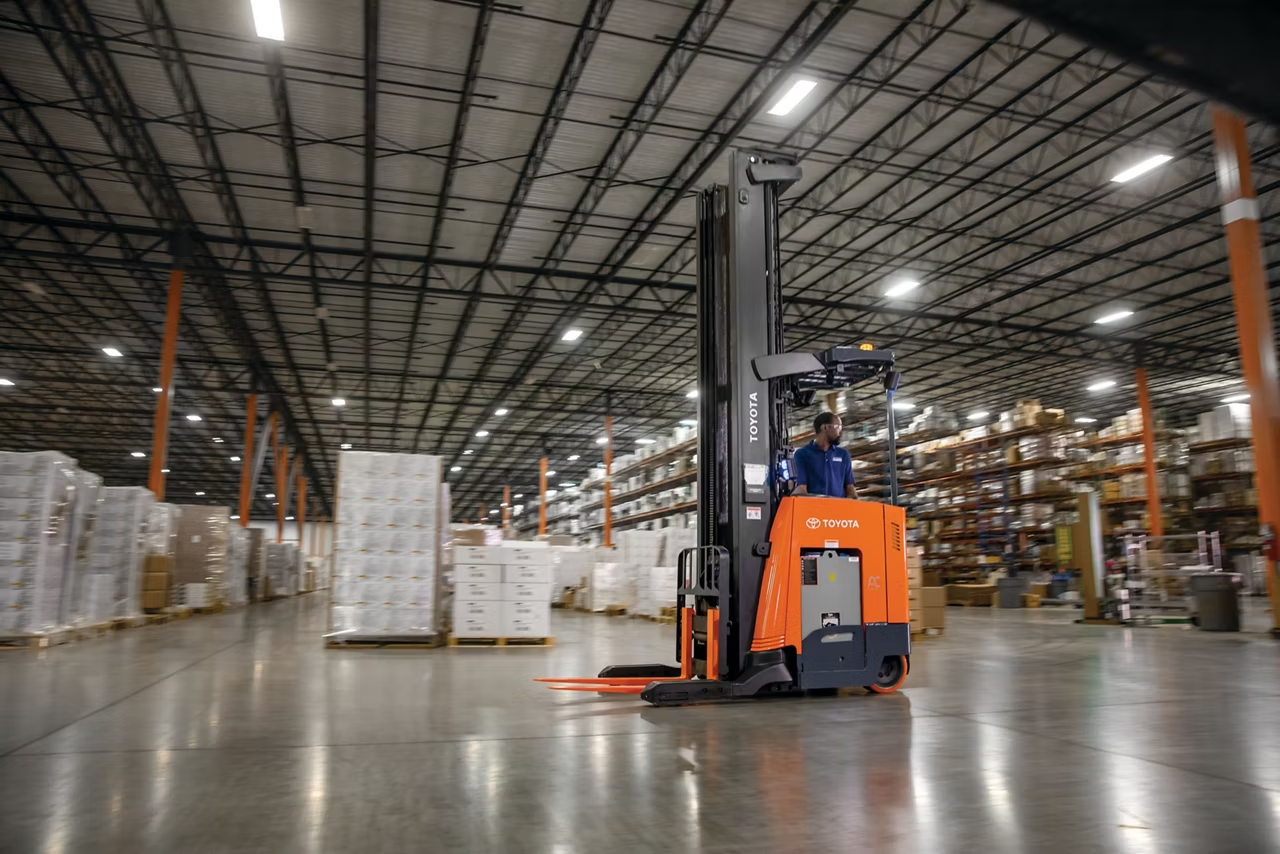
The pantograph is the defining feature of reach trucks.
This mechanism allows the operator to extend and retract the forks while the chassis remains stationary. The additional range of motion allows the forklift to access products up to two pallets deep. With reach trucks, warehouses with large stocks of the same SKU can eliminate some aisle space entirely by storing products on deeper racks.
Likewise, reach trucks allow warehouses to benefit from first-in-first-out and first-in-last-out storage systems without specialized racking.
Order Picking Forklifts
Commonly called order pickers, these forklifts focus on order fulfillment at the item scale rather than the pallet scale.
With these designs, the operator platform moves with the forks, raising and lowering on the mast. This gives the operator easy access to elevated stock. Typically, the operator leans over the platform to retrieve items from an adjacent shelf. Leaning and reaching at height poses a significant fall hazard. To mitigate this, order pickers feature harness systems and tethers to arrest a fall should an operator lose their balance.
Order pickers are excellent choices for itemized fulfillment like e-commerce warehouses.
Dynamic Fleets Rely on Narrow Aisle Forklift Rentals
 Class II forklifts are commonly used in industries with fluctuating inventory demands.
Narrow aisle forklifts are all about maximizing storage space. Consequently, they're favored by industries with many different SKUs, variable stocking levels, or both. Food and beverage warehouses, pharmaceutical companies, and retail stores all regularly use Class II forklifts.
These industries, and others like them, also experience seasonal inventory shifts.
During the slow season, your warehouse may only need a skeleton fleet to meet demand. However, during peak season, a forklift surge is required. You could purchase a fleet to handle busy season volumes, but then you're paying for idle forklifts the rest of the year. Alternatively, you could work your smaller fleet harder during peak season. That puts excess stress on your units, making them more prone to breakdowns. Neither is a great option.
If that sounds familiar, forklift rentals might be the solution you’re looking for.
The Flexibility To Scale
Forklift rentals give you the flexibility to right-size your fleet for every season.
Instead of overbuying or overworking your fleet, you invest in the forklifts you'll use year-round. Then, when demand spikes, you rent the additional trucks you need as they're needed. As demand diminishes, you return your rentals.
When you invest in a fleet that's too large, you’re paying insurance and maintenance fees on units that aren’t earning their keep. Those costs stack up, making a bloated fleet far more expensive than scaling with forklift rentals.
Ultimately, forklift rentals let you fine-tune your fleet on the fly.
Match Truck to Aisles and Products
To justify the investment, the forklifts you buy need to be as useful as possible.
ROI is a huge consideration when investing in any forklift. So, managers tend to choose models that meet the most common applications and minimize the number of specialty forklifts. That makes sense when productivity demands remain relatively constant.
Seasonal inventory shifts complicate fleet planning.
Dynamic stocking leads to different picking requirements. For example, building peaks during the fall could force you to dedicate more of your racks to studs and drywall than you would during the roadwork spikes of the summer. Those awkward loads effectively turn your narrow aisles into very narrow aisles.
You can’t fill the gap by retasking a traditional forklift; there’s no room to turn with those long loads hanging over the forks. However, a Combilift rental would resolve that obstacle. That’s a construction-specific example, but the principle holds true for any industry that experiences seasonal inventory shifts.
Forklift rentals ensure you always have the right forklifts for your aisles and products.
Top-Quality Equipment
You aren’t responsible for the service plan on a rental.
We take care of that. The burden of maintenance rests squarely on our shoulders when it comes to our rental fleet. As a result, you can count on well-maintained, inventory-ready rental equipment. If there’s ever an issue with a rental, we’ll either fix it or swap out the unit.
Either way, you never have to worry about breakdowns and lost productivity when you need it the most.
Our Fleet Is Your Fleet
We're the forklift experts, and it shows in our rental fleet.
It’s easy to spout tips and tricks from behind a keyboard, but we put our expertise into practice with our rental fleet. Better yet, you have convenient access to that high-quality fleet and the experts who maintain it. Effectively, our fleet is your fleet on demand.
To learn more about Class II forklifts or narrow aisle forklift rentals, contact us online or visit one of our locations:
Florida
Jacksonville
Lakeland
Ocala
Orlando
Tampa
Winter Haven
Georgia
Albany
Macon
Columbus
Valdosta
Further Reading
Different Types of Electric Forklifts And What They’re Used For
How to Choose the Right Type of Forklift