


by Adam Gavrun, on Oct 9, 2026, 10:39:10 AM
Since 1896, fewer than 200 people have rowed across the Atlantic Ocean.
That’s an average of three successful attempts every two years. Yet tens of thousands of cargo ships cross the same ocean annually. Ocean kayaks are significantly less expensive. You could buy over 20,000 high-end kayaks for the cost of one cargo ship. From an equipment cost perspective, the kayak should be the preferred vessel for Atlantic shipping fleets.
Yet a shipping fleet of kayaks would be absurd.
Crossing the Atlantic by kayak takes nearly ten times as long as by cargo vessel. A fleet would need over one million kayaks to move as much as even a small cargo ship. No responsible fleet manager would ever choose kayaks over cargo ships. The staffing alone would be a nightmare.
When you purchase the wrong electric forklift, you’re choosing kayaks over cargo ships.
Buying too small is a kayak on the ocean. Buying too big is a freighter in a stream. Neither gets the job done efficiently, and both cost you money every shift.
Electric forklifts have come a long way. Today they handle applications that once belonged almost exclusively to internal combustion (IC) equipment, from standard warehouse work to heavy manufacturing. But picking the right one involves more than matching a truck’s rated capacity to the weight of your load. The equipment has to fit the entire application: environment, lift height, aisle width, travel distance, attachments, shifts, battery technology, and charging opportunities.
Three steps will get you there without overbuying.
1. Understand Your Application and Learn the Types
Choosing the right forklift shouldn’t start with a model number.
It should start with the work the forklift needs to do. Two forklifts with the same rated capacity can perform very differently depending on how and where they’re used. So before you look at a spec sheet, answer these five questions:
- Where will the forklift operate? Indoors, outdoors, cold storage, wet areas, docks, or a combination?
- What are your average and maximum load weights?
- What is the maximum lift height you need?
- How wide are your aisles and the other areas the forklift must navigate?
- How many hours will the forklift run each day, and across how many shifts?
These five answers narrow the field fast. A complete application review goes a bit further. Travel distance affects energy use and productivity. Floor and dock conditions affect tire and configuration choices. Attachments reduce a truck’s effective capacity. Operators who hop on and off all day need a different design than operators who stay seated for a full shift.
Think a few years ahead, too. Changes in production volume, rack height, load size, or operating hours can turn today’s perfect truck into tomorrow’s bottleneck.
You probably know more about the types of forklifts than the average citizen. Still, the lineup evolves fast, and it never hurts to review your options. Below are the most common Toyota electric forklifts and the applications they fit best.
Toyota Walkie Stacker
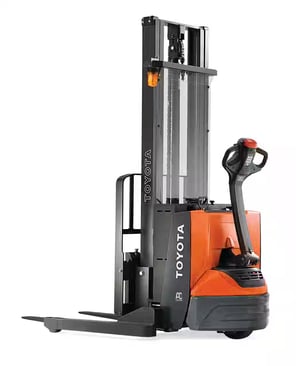 Not every application requires a traditional forklift.
This electric pallet stacker is like an advanced pallet jack, capable of lifting product onto a second-tier rack. It’s an efficient choice for lighter-duty pallet movement and occasional stacking. Best for:
- Environment. Indoor
- Loads. 2,000 to 2,500 lbs.
- 8BWS10: 2,000 lbs.
- 8BWS13: 2,500 lbs.
- Lift. 143 inches
- Aisles. Narrow to standard
- Work Hours. Light to medium use
Toyota 3-Wheel Electric Forklift
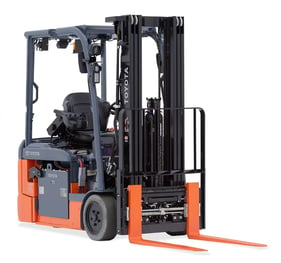 When you need more runtime than a walkie stacker, the 3-Wheel Electric is worth a look.
This counterbalance forklift offers industry-leading runtime, travel speed, and lift speed. The 3-wheel design makes it nimble in tight warehouse spaces. Best for:
- Environment. Indoor or outdoor
- Loads. 3,000 to 4,000 lbs.
- 8FBE15U: 3,000 lbs.
- 8FBES15U: 3,000 lbs.
- 8FBE18U: 3,500 lbs.
- 8FBEH18U: 3,500 lbs.
- 8FBE20U: 4,000 lbs.
- Lift. 119 inches
- Aisles. Narrow to standard
- Work Hours. Medium to heavy use
Toyota Stand-Up Rider Forklift
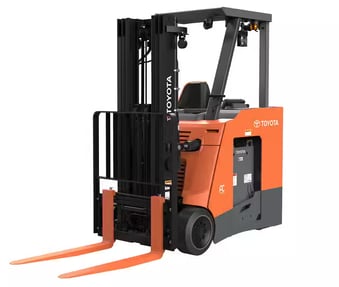
Stand-up forklifts fit high-cycle workflows where operators enter and exit the truck constantly.
Quick on-and-off access boosts productivity in high-throughput warehouses, and ecommerce fulfillment centers love the compact footprint and tall lift. Best for:
- Environment. Indoor
- Loads. 3,000 to 5,000 lbs.
- 8FBA15U: 3,000 lbs.
- 8FBA18U: 3,500 lbs.
- 8FBA20U: 4,000 lbs.
- 8FBA25U: 5,000 lbs.
- Lift. 270 inches
- Aisles. Narrow to standard
- Work Hours. High-cycle, multi-shift
Toyota Core Electric Forklift
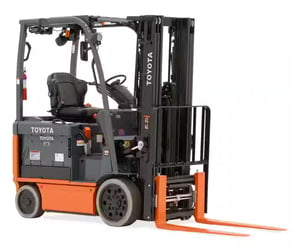 The Core Electric is the most like a traditional forklift.
This four-wheel workhorse handles most of the jobs historically done by IC cushion-tire forklifts, with a low-maintenance, high-reliability design. Best for:
- Environment. Indoor
- Loads. 3,000 to 6,500 lbs.
- 8FBC15U: 3,000 lbs.
- 8FBC18U: 3,500 lbs.
- 8FBC20U: 4,000 lbs.
- 8FBC20U-COMP: 4,000 lbs.
- 8FBC25U: 5,000 lbs.
- 8FBC25U-COMP: 5,000 lbs.
- 8FBCH25U: 5,000 lbs.
- 8FBC28U: 5,500 lbs.
- 8FBC30U: 6,000 lbs.
- 8FBC32U: 6,500 lbs.
- 8FBCH32U: 6,500 lbs.
- Lift. 131 inches
- Aisles. Standard
- Work Hours. Medium to heavy use
If you’ve been happy with the Toyota IC Core Cushion, this is a strong replacement.
Toyota Large Electric Forklift
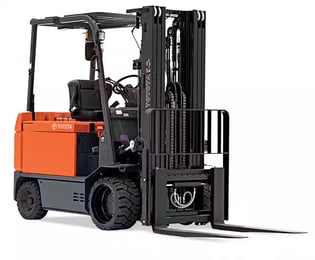 Myth: Electric forklifts are only good for light to medium loads.
Truth: Toyota’s electric line includes models that lift up to 17,500 lbs. Higher-capacity electrics have opened the door for manufacturing, food and beverage, cold storage, and other heavy-load operations that couldn’t go electric a few years ago. When you need more than the Core Electric but less than the 80V Electric Pneumatic, Toyota’s Large Electric Forklift is the middle ground. Best for:
- Environment. Indoor
- Loads. 8,000-12,000 lbs.
- 7FBCU35 - 8,000 lbs.
- 7FBCU45 - 10,000 lbs.
- 7FBCU55 - 12,000 lbs.
- Lift. 120 inches
- Aisles. Standard
- Work Hours. Medium to heavy use
The goal in this step is simple: find the truck that safely meets the demands of the job without paying for capacity or features you’ll never use.
2. Determine Your Runtime and Charging Requirements
Selecting the forklift is only half of an electric solution.
You also have to decide how you’ll power it. The most important question is simple: How long does the forklift need to run between charging opportunities? A truck that works intermittently on one shift has very different energy needs than a high-utilization truck running three shifts.
Before you choose a battery and charging strategy, know your:
- Daily operating hours and number of shifts
- Actual utilization during each shift
- Travel distances
- Breaks and other charging opportunities
- Peak production periods
- Battery charging locations
- Available electrical infrastructure
Lead-Acid or Lithium-Ion?
Battery technology matters as well.
Lead-acid batteries remain an effective, economical solution for many applications. They do require planning for charging schedules, watering, ventilation, and battery changes in high-utilization operations.
Lithium-ion takes a different approach. Opportunity charging during breaks can keep trucks working without battery swaps, and lithium cuts most of the routine battery maintenance. However, lithium isn’t automatically the right answer just because it’s newer. The right battery depends on your utilization, charging windows, electrical infrastructure, and budget.
Don’t Forget the Building
A common mistake is focusing entirely on the forklift and battery while overlooking the facility.
Before converting a fleet or adding several electric forklifts, confirm the building has the electrical capacity and the right locations to support your charging plan. The best electric forklift in the world isn’t productive if it can’t stay charged. Forklift, battery, charger, facility, and schedule work as one system.
3. Compare Total Cost, Then Test It in Your Facility
Purchase price matters, but it shouldn’t be the only number you compare.
The better question is what the equipment will cost to operate over its useful life. When you compare electric and IC options, look at:
- Initial equipment cost
- Fuel or electricity expense
- Battery and charger investment
- Required electrical infrastructure
- Planned maintenance and wear items
- Downtime
- Expected useful life
- Operator productivity
Electric forklifts eliminate engines, engine oil, spark plugs, and the maintenance that comes with them. Weigh those savings against the full electric package, including the battery, charger, and any infrastructure work. The lowest purchase price doesn’t always produce the lowest operating cost, and spending more doesn’t automatically buy more productivity.
Electric forklifts offer plenty of benefits, and more fleets switch every year. But electric isn’t right for everyone. IC forklifts still have their place and won’t disappear any time soon. Run the numbers for your application, and let the math tell you which technology wins.
Then Put It to Work
Spec sheets and spreadsheets will only get you so far.
Every operation is unique. Once the numbers point to a short list, a forklift rental is the best way to confirm your choice. Your operators gain firsthand experience. You collect real data on maneuverability, visibility, ergonomics, runtime, and productivity. If the truck fits, you know exactly what to buy. If it doesn’t, you swap it for the next candidate.
Not every dealer offers electric forklift rentals, and those that do may carry limited models. Our rental fleet includes a wide range of Toyota electric forklifts, so testing the right truck in your facility is easy.
Choosing the Right Electric Forklift Made Simple
There is no single best electric forklift, only the one that fits what your operation needs it to do.
That’s where we come in. Our Solutions Team evaluates material handling applications throughout Florida and Georgia based on real operating requirements, not model numbers. We’ll walk your facility, review your utilization and charging options, and run the total cost comparison so you can invest with confidence. Whether you’re replacing one electric truck, considering lithium-ion, or weighing a full conversion from IC to electric, the free application review comes first.
Let us make choosing the right electric forklift simple.
To schedule your free application review, contact us online or visit one of our locations:
Florida
Jacksonville
Lakeland
Ocala
Orlando
Tampa
Winter Haven
Georgia
Albany
Macon
Columbus
Valdosta
Further Reading
Switch to Electric Forklifts: See How Much You’ll Save
4 Things To Consider When Converting to Electric Forklifts
Forklifts in the Rain: Debunking Electric Forklift Myths