

by Theodore Taylor, on Jun 19, 2026, 9:36:00 AM
Your habits determine your destiny.
Take fitness, for example. Consistent, daily walks are better for your long-term health than running a marathon once a year. The marathon might feel more satisfying, but those gains fade between the finish line and next year’s training regime. Yet, the benefits of a daily walk continue to accumulate over time with far less effort and stress.
Likewise, forklift battery charging habits determine the health of your electric forklift fleet.
Your daily charging procedures stack up. Good habits keep your fleet running longer for less. Bad habits tear up your batteries, escalate downtime, and rack up repair fees. Every fleet wants good charging habits, but sometimes the bad habits are hard to spot.
Read on to learn what bad habits are killing your productivity and which forklift battery charging best practices keep your fleet running.
1. Charging Too Much or Too Little
Think of depth of discharge as a target, not a maximum.
Every forklift battery has a depth of discharge (DoD) rating. This is the percentage of a battery’s capacity it can use before it needs a recharge. Discharging your forklift batteries beyond that point reduces future charging capacity and shortens the lifespan.
However, charging a forklift battery too early is just as bad.
Charging cycles determine a forklift battery’s lifespan. Each model can charge a finite number of times before it fails. The battery’s remaining lifespan decreases by one cycle each time it connects to the charger, even if it's mostly charged. That means charging a battery at 20% discharge ages it just as much as charging it at 50% discharge. Batteries designed for opportunity are the only exception to this rule.
Discharging forklift batteries to their DoD rating before charging helps you get the most out of their lifespan.
2. Skipping Cooldowns
Forklift battery overheating causes significant damage.
Charging and discharging generate a lot of heat. Moving immediately from one to the other builds excessive heat inside the battery. That can lead to leaks, reduced charging capacity, and total failure.
Let forklift batteries cool down between charging and discharging to prevent long-term heat damage.
3. Storing Discharged Forklift Batteries
Never store lead-acid forklift batteries without a charge.
Discharged lead-acid batteries are more prone to sulfation during storage. During sulfation, sulfuric acid crystals grow on the lead plates. The crystals reduce the efficiency of the battery’s internal chemical reactions, limiting its ability to hold a charge.
Avoid prolonged storage when possible and always charge a lead-acid battery before storage.
4. Ignoring Equalization Charges
Even with regular use, battery acid can separate into layers.
During charging and discharge, lead-acid batteries undergo a series of chemical reactions. This creates areas of more concentrated acid and less concentrated acid. The change in concentration is a normal part of the reaction. The more concentrated acid is heavier than the less concentrated acid, causing it to sink and creating two separate layers.
This separation is acid stratification.
The concentration inconsistency creates charge inconsistencies. The bottom, more concentrated layer holds a stronger charge, while the top, less concentrated layer holds less charge. This charge inequality causes battery performance issues.
Equalization charges prevent stratification.
Equalization charges slightly overcharge the battery. The overcharge heats the battery acid, forcing it to mix. Mixing disrupts stratification and maintains a consistent acid concentration throughout the electrolyte solution.
Make equalization part of routine maintenance to optimize battery performance.
5. Neglecting Forklift Battery Charger Maintenance
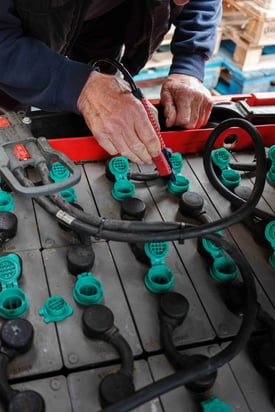 Your forklift batteries are only as good as your battery chargers.
Neglecting charger maintenance can lead to a variety of downstream problems. Loose connectors and damaged wiring create inconsistent charging conditions. Poor connectivity generates excess heat and slows charging, increasing the risk of overheating. Additionally, loose connectors can undercharge batteries, reducing their lifespan.
DIY charger maintenance can be just as bad.
Simple mistakes, like installing new connectors backward, can cause serious damage to both the battery and the charger. Best case, you could end up replacing a few fuses. Worst case, you could have to replace both the charger and the battery. In either case, the downtime slashes productivity.
When balanced against this cost, expert assistance pays for itself.
Our technicians have decades of experience with forklift batteries and chargers. Whether you’re looking for maintenance or repair, their irreplaceable skill set ensures the work is done right the first time. That first-visit-fix mentality increases uptime, extends battery life, and protects your budget.
Don’t let bad charging habits destroy your gains.
Contact us online or visit one of our locations to keep your batteries in shape:
Florida
Jacksonville
Lakeland
Ocala
Orlando
Tampa
Winter Haven
Georgia
Albany
Macon
Columbus
Valdosta
Further Reading
Forklift Batteries 101
Top Tips: How To Maximize the Life of your Forklift Batteries
Bad Forklift Charger Repair Will Kill Your Fleet